Over 2000 Km by road, in around 10 days. Stunning landscapes, wonderful people. That sums up our Ladakh trip. But how did it actually work? How did we make it happen? Read on to find out! Leh, the capital of Ladakh , is accessible by air and road. Flying into Leh is the easiest, and time-saving option, while the road is the time consuming one, but with the added advantage of driving past some of the most beautiful landscapes in our country. Each option has much to recommend it, and we chose the road for just one reason – altitude sickness. Altitude sickness was one of my biggest concerns, since I suffer from motion-sickness. Yes, I do travel a lot, but that is despite my condition, and, over the years, have learnt how to handle it. I struggled with it when we visited Nathu-La in Sikkim, and wondered if I would be able to manage a week at the even higher altitudes that we would encounter in Ladakh. This was the reason we stuck to a basic plan, of only 9 days in Ladakh, thoug...
Monsoon is the season of life, and we see the growth of all kinds of life all around us..... Not even the dead or dying wood is spared, if you notice these bracket fungi growing on them.
This first one is growing on our pomegranate tree, and it is sad to think that the arrival of this fungus means that our tree has not much longer to live.... Of course, it had never been very healthy, not one of its small pomegranates growing into fruits ripe enough for us to taste. Meanwhile, we are making the most of this opportunity to learn about these forms of life too!
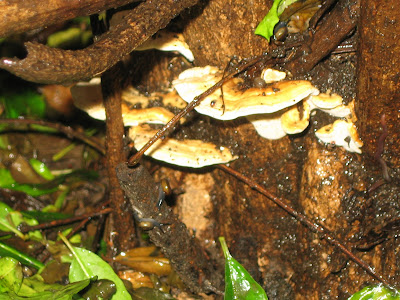
This one grew on a rotting log on the side of the road. I noticed it one day as I went by, and remembered to take my camera along the next day to take a picture. Thankfully, it was still there then, but was gone the very next day!
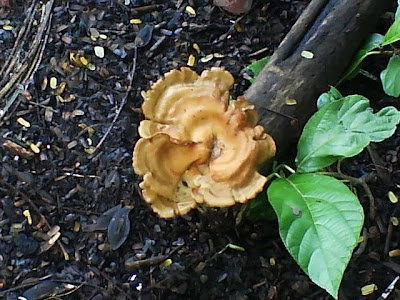
I remember my very first walk into a jungle and our guide pointing out these interestingly shaped things... I even remember bringing back a piece with me (which crumbled in a few days). I remember how thrilled I was then, to see something 'wild'!!! Imagine seeing the same thing in my garden now!!!!

This first one is growing on our pomegranate tree, and it is sad to think that the arrival of this fungus means that our tree has not much longer to live.... Of course, it had never been very healthy, not one of its small pomegranates growing into fruits ripe enough for us to taste. Meanwhile, we are making the most of this opportunity to learn about these forms of life too!
This one grew on a rotting log on the side of the road. I noticed it one day as I went by, and remembered to take my camera along the next day to take a picture. Thankfully, it was still there then, but was gone the very next day!
I remember my very first walk into a jungle and our guide pointing out these interestingly shaped things... I even remember bringing back a piece with me (which crumbled in a few days). I remember how thrilled I was then, to see something 'wild'!!! Imagine seeing the same thing in my garden now!!!!
Maybe too much of rains - The reason.
ReplyDeleteAnyways, thanks for sharing. At-least someone is thinking about them.
Never knew fungi spoils the tree.
ReplyDeleteWe call them 'Bebai sathuli' meaning frog's umbrella. The last picture is like a flower.
I always enjoy watching mushrooms that sprout everywhere in this season! Thanks for telling me more about them.
ReplyDeleteSome of them are edible, but of course don't try them. Some are known to be poisonous too.
ReplyDeleteFantastic captures. As a kid I used to see these a lot. Now I do not see to get them much.
ReplyDeleteAnu
ReplyDeletenice effort and thanks for sharing these pictures with us
Is fungii so dangerous to the tree?
ReplyDeleteVery recently I enjoyed watching these spread completely over a tree. The trees image is posted here. http://subups.blogspot.com/2010/06/achenkovil-temple-in-paradise.html
Didn't know these mushrooms could harm the trees...
ReplyDeleteshows that your garden is growing 'wild' :D
ReplyDelete